
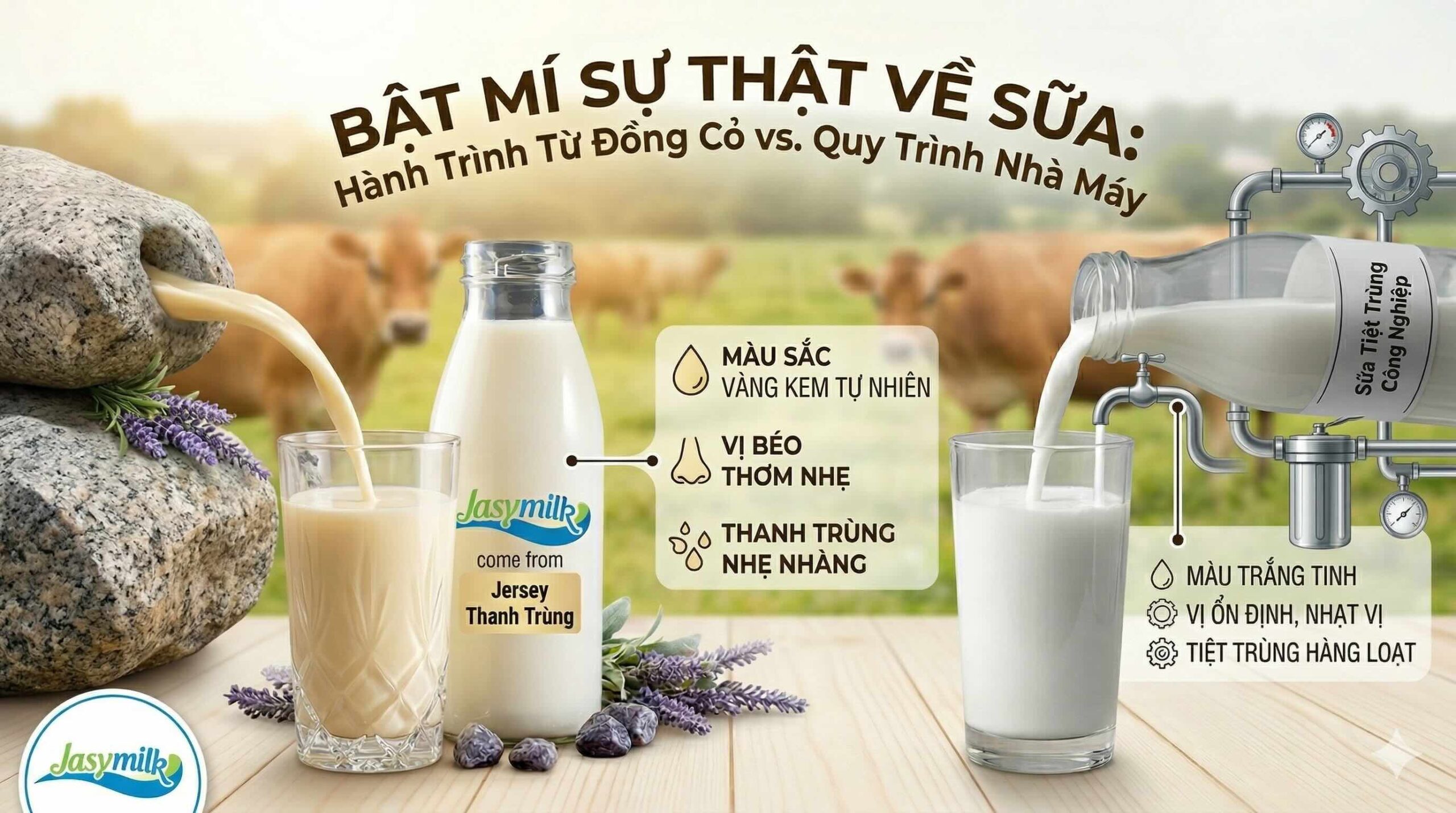
Why does farm-fresh milk taste better than industrial milk? Provide a detailed comparison.
In today’s market, consumers have many choices when buying milk: from large brands to products from small farms.
However, a frequently asked question is:
Is farm-fresh milk really better than factory-farmed milk?
To answer this question, we need to look at the core differences between the two types of milk, from their origin and production process to their nutritional value.
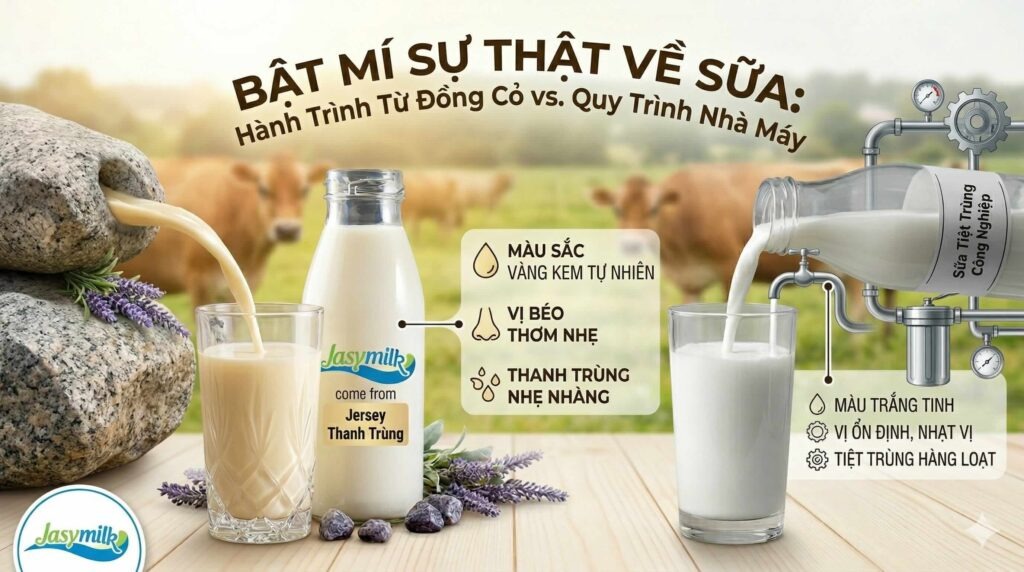
What is farm milk?
Farm milk is milk produced directly on farms, where cows are raised and the milk is processed immediately after milking.
Characteristics of farm-raised milk:
- Clear origin
- Short time from squeezing to use.
- Minimally processed industrially
What is industrially produced milk?
Industrial milk is milk produced on a large scale, undergoing many processing, transportation, and storage stages before being widely distributed in the market.
Characteristic:
- Mass production
- Long shelf life
- Wide distribution
The difference between farm milk and industrial milk.
Origin and environment of livestock farming
In farm-based models, cows are typically raised in a natural environment, with ample space to move around and a controlled diet.
Meanwhile, the industrial model focuses on productivity, so the farming environment may be limited in terms of space and natural conditions.
Time from squeezing to use
Farm milk is typically processed and used within a short time after milking, which helps to preserve its freshness.
Industrial milk undergoes long transportation and storage periods, so it requires more intensive heat treatment.
Processing procedure
Farm-raised milk is often pasteurized to retain its nutrients.
Industrially produced milk often undergoes pasteurization to extend its shelf life, but this can reduce some of the milk’s natural nutritional value.
Flavor
Farm milk tastes like:
- Fresh
- Natural fat
- Mildly fragrant
Processed milk has a stable taste but often doesn’t retain the “fresh” feel.
Nutritional value
Farm-raised milk typically retains more nutrients because it is subjected to less heat treatment.
Processed milk still provides nutrients, but it may have some of its natural vitamins and enzymes reduced.
Why is farm-fresh milk often tastier?
There are three main factors:
Firstly, cows are raised in a better environment, which directly affects the quality of their milk.
Secondly, because the milk is minimally processed, it retains its natural flavor.
Thirdly, the shorter time from production to consumption helps keep the milk fresh.
Does farm-raised milk have any drawbacks?
Farm-raised milk also has some limitations:
- Short shelf life
- Requires refrigeration.
- The cost is usually higher.
However, this is a consequence of preserving the natural quality.
When should you choose farm-fresh milk?
You should choose farm-fresh milk when:
- Prioritize quality and nutrition.
- Can be refrigerated.
- If you want to use truly fresh milk
When should you choose commercially produced milk?
Industrial milk is suitable when:
- Requires long-term storage.
- Travel a lot
- Not suitable for refrigeration.
Jasy Milk – Fresh milk from an ecological farm
Jasy Milk sources its milk from Danifarm, a farm that uses a natural farming model and a strictly controlled production process.
The milk is harvested on the same day and processed using pasteurization to retain as much nutrition as possible.
The product aims for a balance between quality, safety, and natural flavor.
You can find more information here:
[Jasy Milk product link]
Conclude
Both farm-raised and commercially produced milk have their own roles, but in terms of freshness, flavor, and nutritional value, farm-raised milk is still the better choice under suitable conditions.
The choice of milk should be based on usage needs and the priority given to quality versus convenience.
Contact Jasy Milk
If you are looking for fresh farm-sourced milk with a clear origin and transparent process, contact Jasy Milk for advice.